
Timing Pulleys & Synchronous Wheels
Toothed pulleys for GT, HTD, and T-series belts. Precise tooth pitch for steppers, linear stages, and packaging equipment.
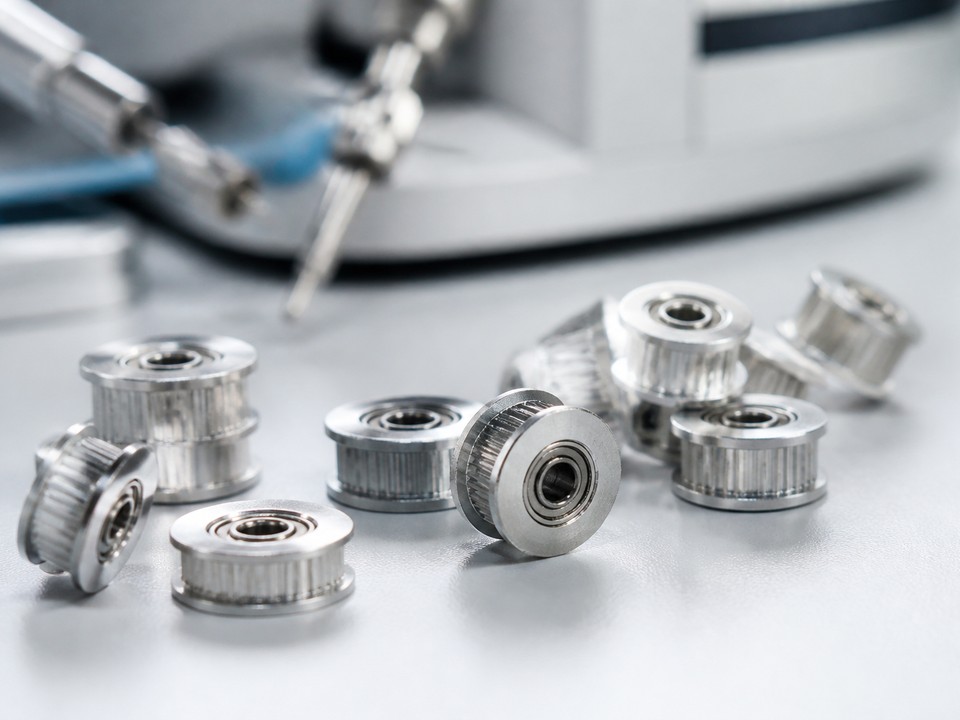
Timing pulley capabilities we quote
GT2/GT3, HTD, T5/T10 and others per belt brand—send the belt part number if unsure
Plain, keyed, set-screw, clamp hub, or bearing ID; fit class on request
Single, double, or flangeless; integral flanges preferred for alignment
6061 aluminum for most automation; steel when tension or wear demands it
Small stepper pulleys through mid-size line shafts—tooth count per print
As-machined, clear/black anodize, or plain steel with oil wipe
Process overview from RFQ to ship
Profile confirm
Match belt pitch and tooth form to your belt part number or drawing. Wrong profile is the #1 return risk—we confirm before cutting.
Turn blank
OD, flanges, and bore turned in one setup when possible so runout stays low for stepper and linear-stage accuracy.
Cut teeth
Hob or mill the synchronous tooth form; deburr grooves so belts seat cleanly without chewing edges.
Inspect pitch & bore
Check tooth spacing/OD, bore, and flange diameter; anodize after inspect when coating is specified.
Pack for assembly
Label profile and tooth count on the bag so your techs grab the right pulley on a multi-axis build.
Timing pulley FAQ
Which belt profiles do you support?
Common GT, HTD, and T-series profiles. Share the belt part number or pitch drawing if you use a specialty profile—we’ll confirm cutter availability before you wait on a quote that can’t be made.
Aluminum or steel?
Aluminum for most automation and prototype work; steel when tooth wear, high tension, or shock loads demand it. We can also anodize aluminum for extra wear resistance.
Can you add flanges later?
Flanges are usually integral for concentricity. Removable flanges are possible on some designs—ask at quote time if you need field-swappable flanges.
Do you sell belts too?
We focus on the machined pulley. You source the belt from your usual supplier; we’ll match the pulley to that belt’s profile and width.
What info makes the quote fastest?
Belt profile or part number, tooth count, belt width, bore, flange style, material, and quantity. A STEP of the pulley is ideal; a dimensioned sketch works for simple hubs.
Pulley DFM tips
- •Put the belt manufacturer and part number on the drawing—pitch drawings alone are easy to misread across GT vs HTD families.
- •Call out flange side relative to the motor or idler; flipping a single-flange pulley is a classic assembly mistake.
- •For high-tension packs, choose steel or hard-anodized aluminum and tell us expected belt tension.
- •If you need a clamp-style hub, give screw size and slot width—or allow us to propose a hub that fits your shaft.
Pitch & bore inspection
- ✓Tooth count and profile family verified against the RFQ/belt number.
- ✓Bore diameter and hub features checked to print; set-screw flats deburred.
- ✓Flange OD and thickness confirmed so belt tracking stays true.
- ✓Optional runout check for precision linear stages and optical equipment.
Lead time & belt matching
Aluminum timing pulleys are among our faster gear-family turns when the profile cutter is on hand—often about 5–8 working days for simple prototypes. Odd profiles or steel blanks may add time. Ordering the matching belt length from your supplier in parallel keeps the line from waiting on our pulley alone.
Related gear solutions
Need timing pulleys for your next build?
Tell us belt profile, tooth count, bore, and flange style for a fast prototype or small-batch quote.
Request a Quote