
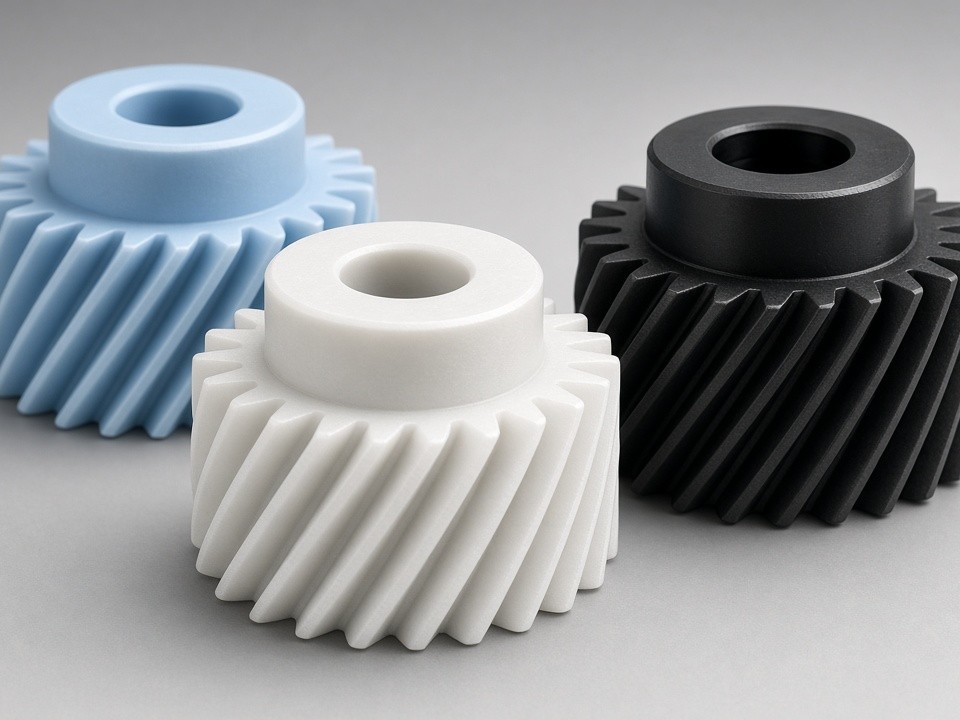
Helical Gears
Angled teeth for quieter mesh and higher load capacity. Common in servo reducers and continuous-duty industrial drives.
Helical gear manufacturing steps
- 1
Print & helix review
We confirm helix hand (LH/RH), helix angle, module, and whether you need a matched pair. Axial thrust direction is noted so your housing bearings are sized correctly—easy to miss when converting from spur.
- 2
Blank turning
OD, face width, hub, and bore are turned so the blank is concentric and ready for helical tooth generation. Critical bores can be left with grind stock if heat treat follows.
- 3
Helix setup & tooth cutting
Hobbing or CNC milling produces the helical tooth form. We set lead and hand from the drawing and cut paired left/right hands when you order a mating set for one gearbox.
- 4
Deburr, secondary ops & measure
Tooth edges are cleaned; we check tooth thickness, helix, and bore. Optional black oxide, anodize, or grind finishes land on the same traveler before pack-out.
- 5
Set documentation
For matched pairs we tag pinion and gear, note backlash intent from the print, and include basic inspection notes so your assembly team can install without re-measuring from scratch.
Materials we cut for helical jobs
Where helical gears fit buyer programs
- Servo & planetary reducers Quieter mesh and higher contact ratio under continuous duty—common upgrade from spur when noise targets tighten.
- Conveyor & packaging drives Helical stages handle longer duty cycles with less tooth slap; we quote wear-friendly steels and optional heat treat.
- Machine tool feed axes When the drawing calls for helical feed gears, we hold helix and bore so backlash stays predictable after install.
- Robot arm gearboxes Compact parallel-shaft helical stages in aluminum or steel for cobot and industrial joints.
- Pump & mixer inputs Continuous-running industrial reducers where spur noise or contact stress becomes the limiting factor.
- Retrofit replacements Match an OEM helical with measured helix, hand, and center distance when the catalog part is obsolete.
Helical DFM tips
- •Always state helix hand and angle on both members of a pair—mirrored CAD exports are a frequent quote error.
- •Account for axial thrust: helical gears push bearings; tell us if the housing already has thrust capacity.
- •Order mating gears together when backlash and contact pattern matter; cutting them months apart invites mismatch.
- •For aluminum helicals in high-cycle automation, consider hardcoat anodize on the OD/teeth only if wear is the concern—mask bores.
Inspection checkpoints
- ✓Helix hand and angle verified against the print before tooth cutting proceeds past first-off.
- ✓Tooth thickness / span and bore diameter recorded for the ship packet on critical jobs.
- ✓Visual mesh check on matched pairs when you supply a mating sample or both blanks ship together.
- ✓Surface finish and deburr on tooth flanks—especially important for quiet servo applications.
Lead time & sets
Single helical prototypes typically track similar to spur gears (about a week after DFM when cutters/stock are ready). Matched LH/RH sets and heat-treated lots need extra schedule—ask for a set quote with shared blanking so both members leave on the same ship date.
Helical gear FAQ
Spur vs helical—when should I switch?
Choose helical when you need quieter mesh, higher contact ratio, or the OEM design already specifies it. Stay with spur for simplest inspection, lowest axial thrust, and the fastest prototype path.
Can you cut only one member of a helical pair?
Yes, but we strongly prefer both drawings (or a sample of the mate). Without helix hand, angle, and center distance confirmed, drop-in fit is a gamble.
What helix angles do you support?
Whatever the print specifies within practical cutter reach—common industrial angles land in the teens to ~30°. Extreme angles may need process notes; we’ll flag that at quote.
Quote helical gears as singles or sets
Include helix angle, hand, module, face width, and mating gear notes so we can quote accurately—with DFM and a clear lead-time window.
Get a Quote