
Flexible Insulated Bus Bar
Flexible insulated bus bars carry high current while absorbing vibration, misalignment, and thermal expansion that would fatigue rigid bars or oversize cables. Partsproto supplies flexible copper and aluminum solutions with insulation options such as PVC and silicone, fabricated to your length, hole pattern, and bend envelope for vehicles, machinery, and power electronics.
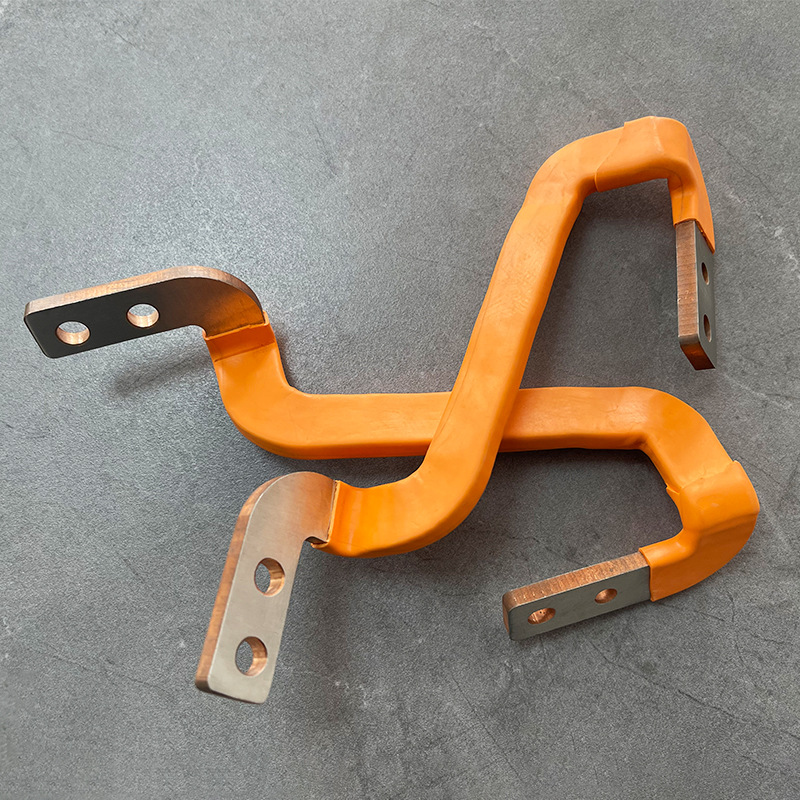
Where flexible bus bars win
Rigid bars are efficient but intolerant of relative motion between terminals. Flexible constructions—laminated foils, braided straps, or thin multi-leaf stacks—add compliance while keeping resistance lower than an equivalent long cable run in many layouts.
Insulation is not cosmetic: it sets creepage, abrasion resistance, and temperature class. Silicone suits higher temperature and flexibility; PVC is common for general industrial duty. Always match insulation to ambient and nearby heat sources.
Partsproto quotes flexible links as engineered conductors: share motion range, current, and envelope so we do not underspecify leaf count or overspecify cost.
Flexible links also simplify tolerance stack-up between independently mounted cabinets. Instead of forcing perfect alignment of rigid bars, a short flex section absorbs a few millimeters of misalignment without stressing terminals.
Manufacturing approach
Ends are typically solid or pressed terminals with CNC holes for bolting; the mid-span provides flex. We control insulation cutback so bare contact length matches your terminal stack without exposing live edges unexpectedly.
Laminated flexible bars need clean interlayer edges and consistent pressing. Braided styles need ferrule or welded end preparation. We select the construction that fits your drawing rather than forcing one process family.
Tests often include dimensional envelope checks, insulation integrity inspection, and continuity. Dynamic life testing is usually customer-owned unless scoped separately.
Insulation abrasion is the field failure mode to watch: clamps, sheet-metal edges, and vibration can wear jackets. Specify anti-abrasion sleeves or routing clearances when the path is rough.
Ordering tips
Provide free length, bend radius limits, motion diagram if available, current, insulation type, and end-hole patterns. Photos of the installation help when drawings omit cable-tray obstacles.
Do not assume a flexible bar can replace a rigid bar at the same cross-section without reviewing temperature rise—flex constructions can run warmer depending on cooling.
Start the RFQ at /contact with prototype quantities; flexible insulated parts often have longer lead times than solid flats.
If you need a specific bend radius for installation only (one-time form) versus continuous flex, say which. One-time form can use different constructions than high-cycle motion.
Specifying flex without overbuying
Over-specifying flexibility wastes money and can make bars floppy enough to need extra supports. Under-specifying causes cracked ends at the terminal. A short motion sketch—millimeters of travel and cycles per day—beats vague words like “high vibration.”
Temperature class of the insulation must clear both ambient and self-heating. A jacket rated for cool cabinets can harden or crack near resistors and heatsinks. Share nearby heat sources on the RFQ.
Installation bend is different from service flex. Some bars are formed once into an L or S and then sit still; others wave continuously. Constructions differ—label which duty you need.
Include length, end patterns, insulation, and motion notes at /contact for a construction recommendation and quote.
Partsproto quotes flexible insulated bus bars with the same export discipline as solid bars: clear drawings, stated insulation class, and packing that protects jackets. If you are unsure whether you need flex, laminated, or solid, describe the motion and current and we will recommend a construction.
Flexible bus bar checklist
List free length, end hole patterns, insulation type and temperature class, continuous current, and whether duty is one-time form or continuous flex.
Add ambient temperature, nearby heat sources, and any abrasion risks along the route. Photos of the path beat long email threads.
If replacing cable, compare not only ampacity but also inductance and clamp points. Flexible bus is not automatically better—it is better when packaging and motion say so.
Request a construction recommendation and quote through /contact; Partsproto will say when a solid or laminated rigid bar is the smarter buy.
Key Features
Discover the unique characteristics and advantages of Flexible Insulated Bus Bar
Motion and vibration compliance
Absorbs relative movement between terminals that would crack rigid bars or loosen joints.
Built-in electrical insulation
PVC, silicone, or custom jackets for creepage and abrasion protection.
Lower inductance than long cables
Short flexible links keep loop area small in power electronics layouts.
Custom end patterns
CNC holes and terminal shapes matched to your bus or device pads.
Copper or aluminum flex options
Material chosen for conductivity, weight, and cost targets.
Export packing that protects jackets
Insulation is shielded from crush and abrasion in transit.
Technical Specifications
Detailed specifications for Flexible Insulated Bus Bar
Materials
Dimensions
Thickness: 0.5 mm to 10 mm (stack / typical)
Width: 10 mm to 200 mm (typical)
Finish Options
Applications
Explore the various applications where Flexible Insulated Bus Bar excels
Vehicle and mobile equipment
Links that see chassis flex and road vibration.
Industrial machinery
Connections between vibrating motors, drives, and cabinets.
Power electronics
Short flexible DC links between capacitors, switches, and laminated buses.
Battery pack interfaces
Module-to-pack links needing compliance for tolerance stack-up.
Retrofit between misaligned panels
Takes up hole-pattern mismatch without forcing enclosures.
Test racks
Reusable flexible jumpers for burn-in and validation stands.
Advantages
- •Handles vibration and thermal expansion
- •Insulation improves safety in tight spaces
- •Can reduce cable bulk in high-current runs
- •Custom lengths and end patterns
- •Useful bridge between rigid bus sections
- •Supports copper and aluminum strategies
Limitations
- •Usually higher cost than solid flats
- •Ampacity must account for construction and cooling
- •Insulation inspection needed in abrasive environments
- •Dynamic life depends on bend radius and duty cycle
Frequently Asked Questions
Find answers to common questions about Flexible Insulated Bus Bar
What insulation types do you offer?
PVC and silicone are common; custom jackets are quoted when temperature or chemical exposure demands them. State ambient and peak temperatures on the RFQ.
How much flex do I need?
Describe motion amplitude and frequency, or provide a sketch. Undersized flex fails early; oversized flex costs more and may need support.
Flexible vs laminated rigid bus?
Flexible insulated bars prioritize motion. Laminated rigid bars prioritize low inductance in fixed geometries. Many systems use both.
Can ends be tin or silver plated?
Yes when the construction allows plating on terminal ends. Specify plating on the drawing.
What is typical lead time?
Longer than simple solid bars because of insulation and stack processes. Dates are quoted per design.
Do you rate ampacity?
We can discuss section and construction, but final ampacity and temperature-rise approval belong to your electrical design and standards.
How should I order?
Send envelope drawings and motion notes via /contact, plus quantity and insulation preference. Avoid clamping flexible sections tightly in the middle of the flex zone; clamps belong on reinforced ends so the jacket and leaves can move as designed.
Ready to Get Started?
Contact us today to discuss your Flexible Insulated Bus Bar requirements and get a customized solution for your application.