Custom Bus Bar
Custom bus bars machined and fabricated to your drawings for power distribution, battery packs, switchgear, and industrial panels. Partsproto supports copper and aluminum geometries—from punched flats to multi-bend assemblies with plating or insulation—quoted for prototypes through production export. Share CAD, ampacity notes, and finish requirements for a practical DFM review before metal is cut.
What a custom bus bar is
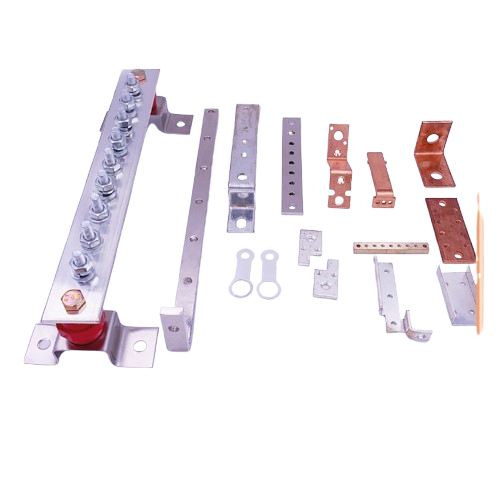
A bus bar is a rigid or semi-rigid conductor that carries current between components more efficiently than discrete cabling in compact assemblies. Custom designs start from your ampacity, voltage class, enclosure space, and connection scheme—terminal holes, studs, bends, and insulation cutbacks—rather than a catalog length.
CNC machining and sheet fabrication let us hit hole patterns, radii, and thickness that hard-tooled stamps cannot change quickly. That matters when you are iterating a battery module layout, a UPS cabinet, or a retrofit into legacy switchgear.
Partsproto is a mid-size CNC and electrical-parts supplier exporting overseas. We coordinate material, machining, forming, and common finishes with soft capability language—precision work without inventing aerospace process theater you did not ask for.
Custom work also covers hybrid needs: a mostly solid bar with a short flexible link welded or bolted at one end, or a copper spine with aluminum extensions where weight must drop. Call those transitions out early so plating and joint practice stay coherent.
How we manufacture custom bus bars
After RFQ we review CAD or 2D drawings for DFM: bend allowances, plating mask areas, minimum edge distance to holes, and whether laminated or solid construction is the better fit. Clear current rating and ambient assumptions help us flag undersized sections early.
Typical flow is material cut to blank, CNC mill or punch for profiles and holes, press-brake or dedicated bending, deburr, plating or insulation, dimensional and continuity checks, then export packing. Complex parts may add soft jaws, fixtures, or staged plating.
Lead time depends on geometry, finish, and quantity. Simple tin-plated copper flats often move faster than multi-layer laminated assemblies with custom insulation. We quote realistic China-to-destination schedules rather than best-case shop-floor hours alone.
Secondary operations—PEM nuts, welded studs, riveted contacts, or selective powder coat—are scheduled after the primary geometry is stable. Changing hole pitch after studs are welded creates scrap; freeze interfaces before those ops.
Design and ordering tips
Send STEP or DXF plus a PDF with critical dimensions, material grade, finish, and any CTQ callouts. Note which faces must stay bare for electrical contact and which need insulation or plating. If you have a preferred plating thickness or insulation material such as PVC, heat-shrink, or epoxy powder, say so on the RFQ.
Call out mating hardware—M6/M8 studs, PEM nuts, welded bolts—and torque expectations when known. Mixed copper-to-aluminum joints need compatible plating and joint compound guidance; flag galvanic concerns early.
For first articles, identify three to five dimensions that actually control fit. We can inspect those tightly and use standard shop practice elsewhere, which keeps cost down without risking the interface. Request a quote at /contact.
If you only have a sample, we can reverse-measure many solid bars and issue an approval drawing. For laminated or proprietary insulated samples, expect more discovery questions before a firm price.
Export buyers: what to expect from Partsproto
Overseas buyers usually care about three things besides price: whether the bar fits the first time, whether plating and insulation match the print, and whether packing survives freight. Our quoting process asks for ship-to country and inspection needs up front so those items are priced, not discovered at the dock.
Communication is drawing-centric. We respond with marked-up DFM notes when something will hurt cost or yield—tiny internal radii, plating on threads, impossible bend radii—rather than silently making a part that cannot assemble. You approve the approach before we cut production metal on ambiguous jobs.
Repeat orders use the frozen revision. If your enclosure supplier changes a hole pattern, send a new revision; we will not assume last year’s DXF still applies. That discipline is what keeps custom bus bar programs stable across multiple shipments.
Ready to start? Upload files at /contact with material, finish, quantity breaks, and any cert needs. We will come back with questions only where the drawing is silent, then a dated quote.
Key Features
Discover the unique characteristics and advantages of Custom Bus Bar
Drawing-driven geometry
Profiles, hole patterns, and bend sequences follow your CAD so the bar drops into the enclosure without field rework.
Material matched to the duty
Copper for high conductivity and compact sections; aluminum when weight or cost dominates and section can grow.
Finish and insulation coordination
Tin or silver plating for contact surfaces, bare where specified, plus sleeves or coatings when clearance is tight.
Prototype-to-production path
Same process family from pilot lots to repeat orders so DFM lessons carry into volume.
Export packing discipline
Separated contacts, labeled bags, and protective wraps suited to overseas freight.
Practical DFM feedback
We flag undersized sections, risky bend radii, and plating mask issues before metal is cut.
Technical Specifications
Detailed specifications for Custom Bus Bar
Materials
Dimensions
Thickness: 0.5 mm to 20 mm (typical)
Width: 10 mm to 500 mm (typical)
Finish Options
Applications
Explore the various applications where Custom Bus Bar excels
Battery packs and ESS
Module interconnects and pack-level links where hole pitch and plating must match terminals.
Switchgear and MCC
Main and distribution bars sized for panel ampacity and clearance rules.
UPS and power electronics
Short, low-impedance runs between breakers, capacitors, and inverter stages.
Industrial machines
Cabinet power distribution for CNC, welders, and process equipment.
Renewable inverters
DC and AC bus links inside solar and storage conversion cabinets.
Retrofit and legacy
Form-fit replacements when OEM bars are obsolete but the enclosure remains.
Advantages
- •Geometry matched to your enclosure and terminals
- •Copper or aluminum by conductivity vs weight and cost
- •Plating and insulation options for contact and clearance
- •DFM support before production metal
- •Works for prototypes and repeat production
- •Export-oriented packing and documentation
Limitations
- •Lead time grows with bends, plating, and insulation complexity
- •Extreme thin or thick sections may need process review
- •MOQ can apply for plated or laminated builds
- •Final electrical validation remains with the system designer
Frequently Asked Questions
Find answers to common questions about Custom Bus Bar
What files do you need to quote a custom bus bar?
Prefer STEP or DXF plus a PDF with material, finish, critical dimensions, and quantity. Photos of the mating assembly help when drawings are incomplete.
How long does a typical custom bus bar take?
Many machined and tin-plated copper or aluminum bars quote in the multi-week range depending on finish and lot size. Laminated or heavily insulated parts usually take longer—ask for a date on the quote.
Is there a minimum order quantity?
We support prototypes and small lots. Plated or laminated jobs may carry a practical MOQ because of bath and tooling setup; we state that on the quote.
Can you reverse-engineer from a sample?
Yes for many solid bars: we measure, create a drawing for approval, then manufacture. Laminated stacks and proprietary insulation need more clarification.
Do you provide material certificates?
Material certs and plating reports can be included when requested at RFQ so we plan paperwork with the job.
Copper or aluminum for a custom design?
Copper when space is tight or conductivity is critical. Aluminum when weight or cost matters and you can increase cross-section. We help size either from your ampacity notes.
How do I get a quote?
Send drawings and requirements via /contact. Include target ampacity, finish, quantity, and ship-to country for a realistic landed quote.
Ready to Get Started?
Contact us today to discuss your Custom Bus Bar requirements and get a customized solution for your application.